Q3 2026 Market Outlook: Adapting in a Higher-for-Longer Rate Environment
What happened in Q2 2026?
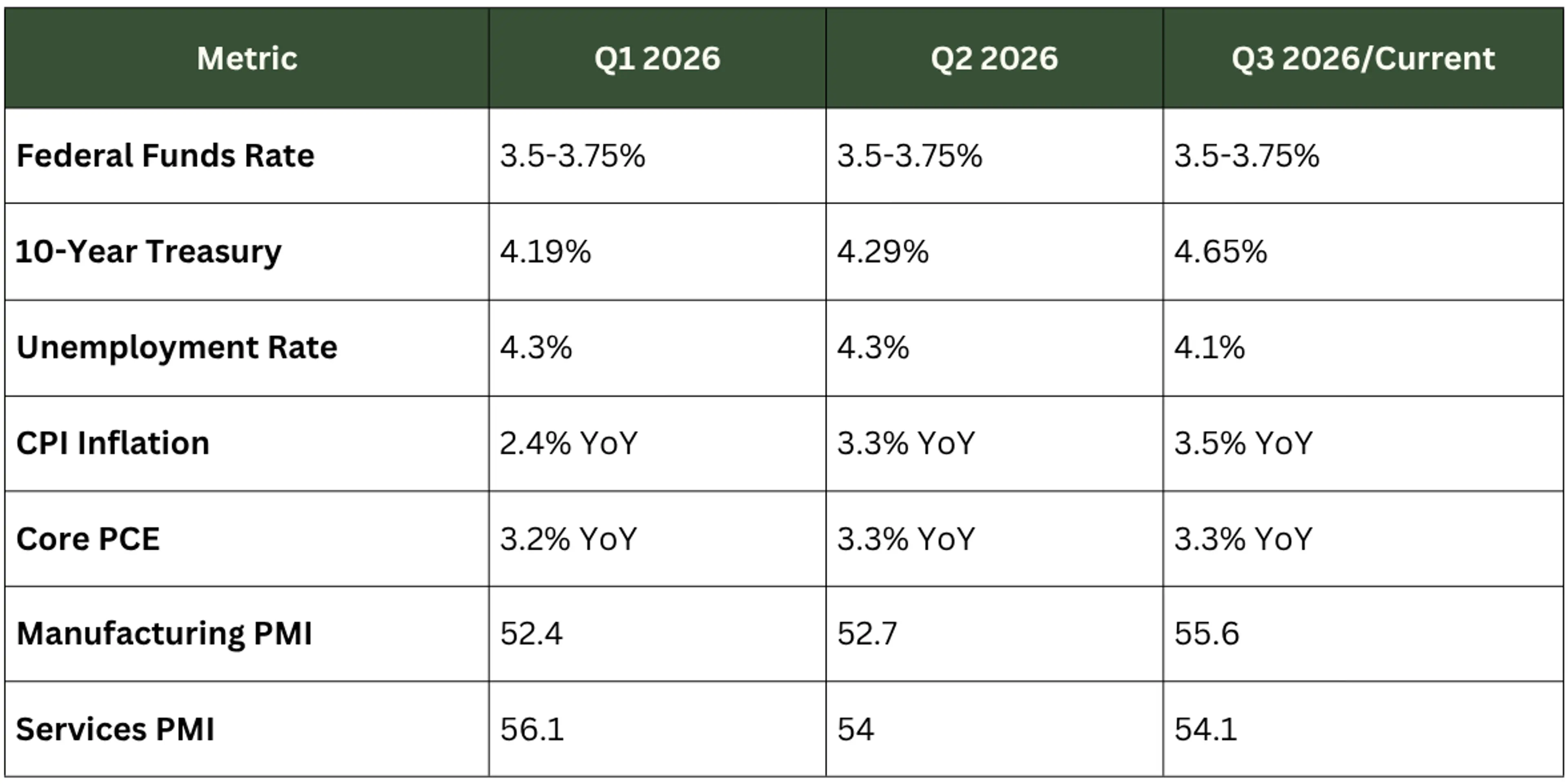
Q2 confirmed a shift that had been building since late last year. The businesses waiting for interest rates to fall are still waiting, and the ones that stopped waiting are the ones getting ahead. Manufacturing extended its expansion streak¹, small business activity held its ground², and unemployment ticked down to 4.1%³.
But the real story of the quarter was reacceleration. Inflation climbed higher⁴, the Federal Reserve signaled fewer cuts ahead⁸, and long-term borrowing costs pushed upward⁵. For business owners, the "higher-for-longer" rate environment stopped being a forecast and became the operating reality.
Key Economic Indicators: Q1 2026 → Q2 2026 → Q3 2026
Where are interest rates headed?
Interest rates are likely to stay higher for longer. The Federal Reserve held the federal funds rate at 3.50-3.75% through Q2 2026⁷, and with inflation reaccelerating to 3.5% year over year⁴, the Fed revised its own projections toward fewer cuts in 2026. Long-term borrowing costs have moved independently of Fed policy - the 10-year Treasury yield climbed as high as 4.65%⁵ during the quarter, higher than when rate cuts began in late 2025. For business owners, the practical message is that meaningful rate relief is unlikely in the near term, and capital structures should be built for today's environment rather than an anticipated lower-rate future.
Why is inflation still a concern?
Inflation remains a concern because it has climbed back above the Federal Reserve's 2% target rather than continuing to cool. After falling to 2.4% year over year in early 2026, CPI rose to 3.5% year over year in the most recent reading⁴, while Core PCE - the Fed's preferred gauge - eased slightly to 3.3%⁹. These levels signal that price pressures are proving sticky, not temporary. For businesses, persistent inflation limits the Fed's ability to cut rates, which keeps borrowing costs elevated and makes access to flexible capital more important than price alone.
How are small businesses responding?
The NFIB Small Business Optimism Index² held near its long-run average through Q2. Business owners continued to prioritize execution on deferred plans rather than waiting for conditions to improve.
"For two years, business owners waited for rates to come down," notes John Paradisi, CEO of Libertas Funding. "The ones getting ahead have stopped waiting. They are building capital structures that work regardless of where the Fed lands next. How you access capital matters as much as what it costs."
What does this mean for capital access?
Traditional bank lending standards remain conservative. Regional and community banks continue cautious underwriting, creating an opening for specialized lenders who can move at the speed businesses require.
Private credit has become an increasingly important part of the capital ecosystem, not as a compromise, but as a competitive advantage for businesses with time-sensitive opportunities. Market data underscores why underwriting quality matters here: Fitch Ratings reported a record 6% default rate among private debt borrowers in the second quarter of 2026¹¹, a reminder that not all private capital is underwritten the same way. Having supported over $5 billion¹⁰ in growth capital since 2016, Libertas continues to help businesses execute through these market transitions.
Built for a higher-for-longer world
If you're planning your next move in this rate environment, Libertas provides growth capital built for speed and flexibility.
Let's Talk Growth.
Sources:
- Institute for Supply Management, Manufacturing PMI Report, June 2026.
- National Federation of Independent Business, Small Business Economic Trends.
- Bureau of Labor Statistics, Employment Situation Summary, June 2026.
- Bureau of Labor Statistics, Consumer Price Index Summary.
- U.S. Department of the Treasury, Daily Treasury Par Yield Curve Rates (as of 7/23/2026).
- Institute for Supply Management, Services PMI Report, June 2026.
- Federal Reserve Board, FOMC Statement, June 2026.
- Federal Reserve, Summary of Economic Projections, June 2026.
- Bureau of Economic Analysis, PCE Price Index Excluding Food and Energy.
- Total originations facilitated since inception (2016). As of 7/23/2026.
- Fitch Ratings, U.S. Leveraged Finance Default Insight, Q2 2026, as reported by Bloomberg, August 3, 2026.
This material is provided for informational purposes only and does not constitute financial advice or an offer to provide financing.
Term Loans are issued by WebBank and serviced by Libertas pursuant to its partnership with the Bank.
About Libertas Funding
Founded in 2016 and headquartered in Greenwich, CT, Libertas Funding has facilitated over $5 billion¹⁰ in growth capital to small and medium-sized businesses. The company combines institutional-grade execution with personalized service. Learn more at libertasfunding.com.