Market Outlook: Structure Over Costs
What happened in Q1 2026?
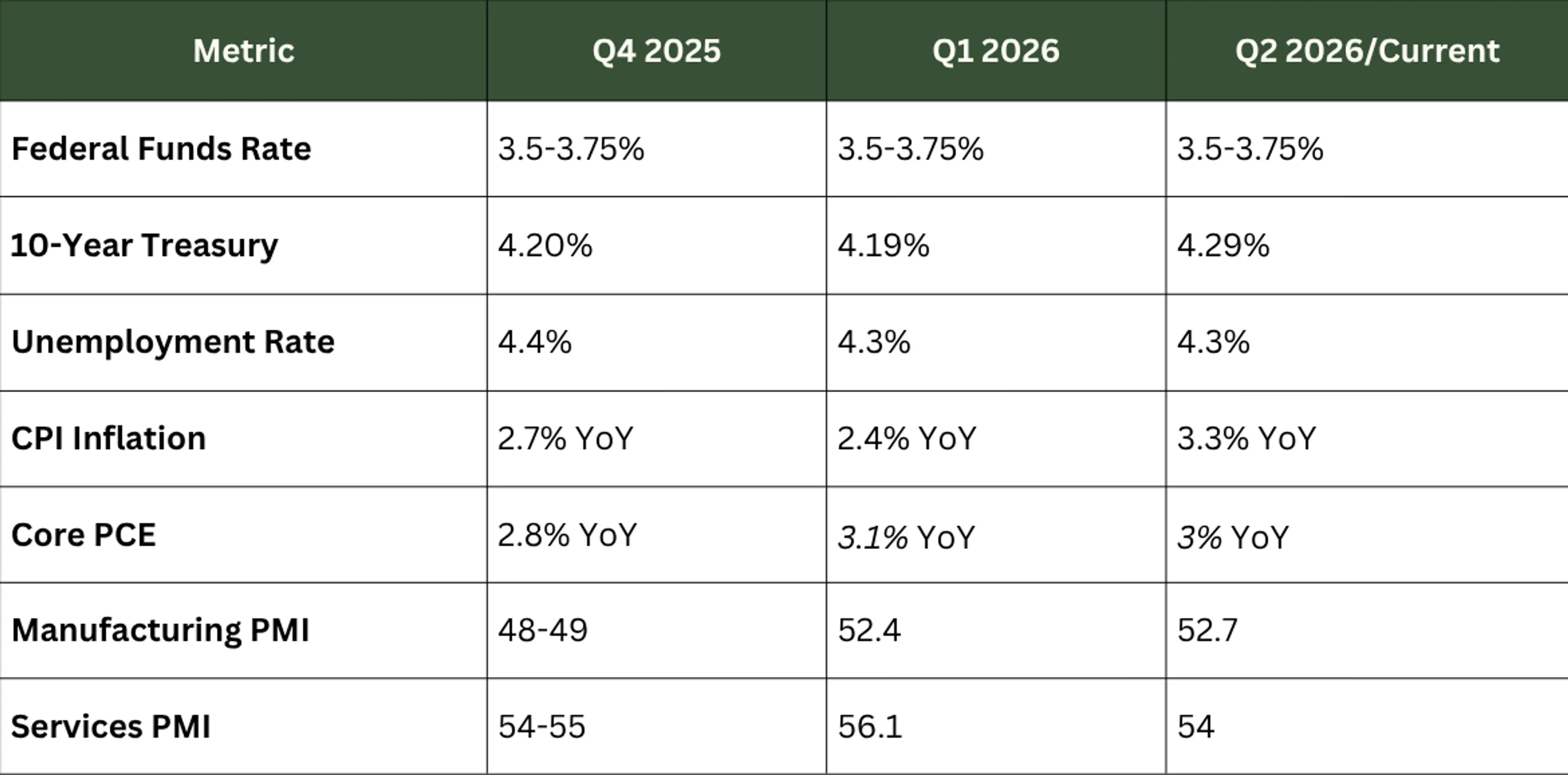
Q1 confirmed an economic turning point. Manufacturing returned to expansion for the first time since mid-2024⁷, small business confidence held above its 52-year average⁹, and businesses that invested in Q4 2025 saw returns on those decisions.
But heading into Q2, the landscape is shifting. Inflation has reaccelerated⁴, borrowing costs remain elevated², and the Federal Reserve has signaled it's in no rush to cut further¹.
Key Economic Indicators: Q4 2025 → Q1 2026 → Q2 2026
Where are interest rates headed?
The Federal Reserve held the federal funds rate steady at 3.50–3.75% through Q1¹. Despite three 25-basis-point cuts in H2 2025, the 10-year Treasury yield ticked up to 4.29%² — higher than when cuts began.
"The Fed has limited room to maneuver," notes Jia-Mang Ten, Chief Investment Officer at Libertas Funding. "With inflation reaccelerating and trade policy still in flux, rate relief is unlikely in the near term. Businesses should plan accordingly."
Further rate cuts are unlikely before H2 2026 at the earliest. Elevated borrowing costs are the operating reality, not a temporary condition.
What changed with tariffs?
Tariff-driven uncertainty dominated 2025, but the Supreme Court's recent ruling⁶ has eased some near-term pressure. The broader trade policy environment remains fluid, though the immediate impact on business decision-making has moderated. The focus has shifted to macroeconomic factors: borrowing costs, inflation, and capital access.
How are small businesses responding?
The NFIB Small Business Optimism Index⁹ remained above its 52-year average through Q1. Business owners are prioritizing execution on deferred plans — the same dynamic that emerged in Q4 2025.
"Tariffs slowed decision-making in 2025, but the conversation has shifted," notes John Paradisi, CEO of Libertas Funding. "Now the real question is borrowing costs and access to capital. How you access capital matters as much as what it costs."
What does this mean for capital access?
Traditional bank lending standards remain conservative. Regional and community banks continue cautious underwriting, creating an opening for specialized lenders who can move at the speed businesses require.
Private credit has become an increasingly important part of the capital ecosystem — not as a compromise, but as a competitive advantage for businesses with time-sensitive opportunities. Having facilitated over $5 billion¹⁰ since 2016, Libertas continues to support businesses through these market transitions.
Read the full analysis
This is a summary of our full Q1 2026 market review and Q2 2026 outlook. Download the full report below.
Sources:
- Federal Reserve Board, FOMC Statements, 2025–2026
- U.S. Department of the Treasury, Daily Treasury Yield Curve Rates (as of 4/23/2026)
- Bureau of Labor Statistics, Employment Situation Summary, March 2026
- Bureau of Labor Statistics, Consumer Price Index Summary
- Bureau of Economic Analysis, PCE Price Index Excluding Food and Energy
- Supreme Court of the United States, Opinion No. 24-1287
- Institute for Supply Management, Manufacturing PMI Report, March 2026
- Institute for Supply Management, Services PMI Report, March 2026
- National Federation of Independent Business, Small Business Economic Trends
- Total originations facilitated since inception (2016). As of 4/23/2026.
This material is provided for informational purposes only and does not constitute financial advice or an offer to provide financing.
Term Loans are issued by WebBank and serviced by Libertas pursuant to its partnership with the Bank.
About Libertas Funding
Founded in 2016 and headquartered in Greenwich, CT, Libertas Funding has facilitated over $5 billion¹⁰ in growth capital to small and medium-sized businesses. The company combines institutional-grade execution with personalized service. Learn more at libertasfunding.com.