Market Outlook: Optimism Takes Hold Despite Elevated Rates
Q4 2025 Review and Q1 2026 Outlook
As 2025 closed, a notable change emerged in the small business landscape: confidence returned even as borrowing costs remained elevated. While the Federal Reserve cut rates three times in the second half of the year, long-term rates failed to follow, keeping capital costs higher than many expected. Yet businesses moved forward anyway—turning improved sentiment into action during the holiday season and laying plans for growth in early 2026. Early 2026 data suggests those businesses read the economy correctly.
In Q4, businesses stopped waiting for ideal conditions and began executing under imperfect ones. The question for 2026 isn't whether the economic environment will improve, but whether this willingness to act can sustain itself.
Q4 2025 Review: Action Over Perfection
The fourth quarter of 2025 showed that businesses are willing to move forward with imperfect information rather than wait indefinitely for ideal conditions. After months of caution earlier in the year, companies began executing on capital plans they had deferred.
Consumer spending reflected this shift. Holiday retail sales exceeded expectations despite credit card rates hovering above 20%¹, and small business confidence indices rose to their highest levels in over a year. Businesses decided that acting on their strategic plans mattered more than waiting for perfect economic conditions.
The Rate Environment Reality
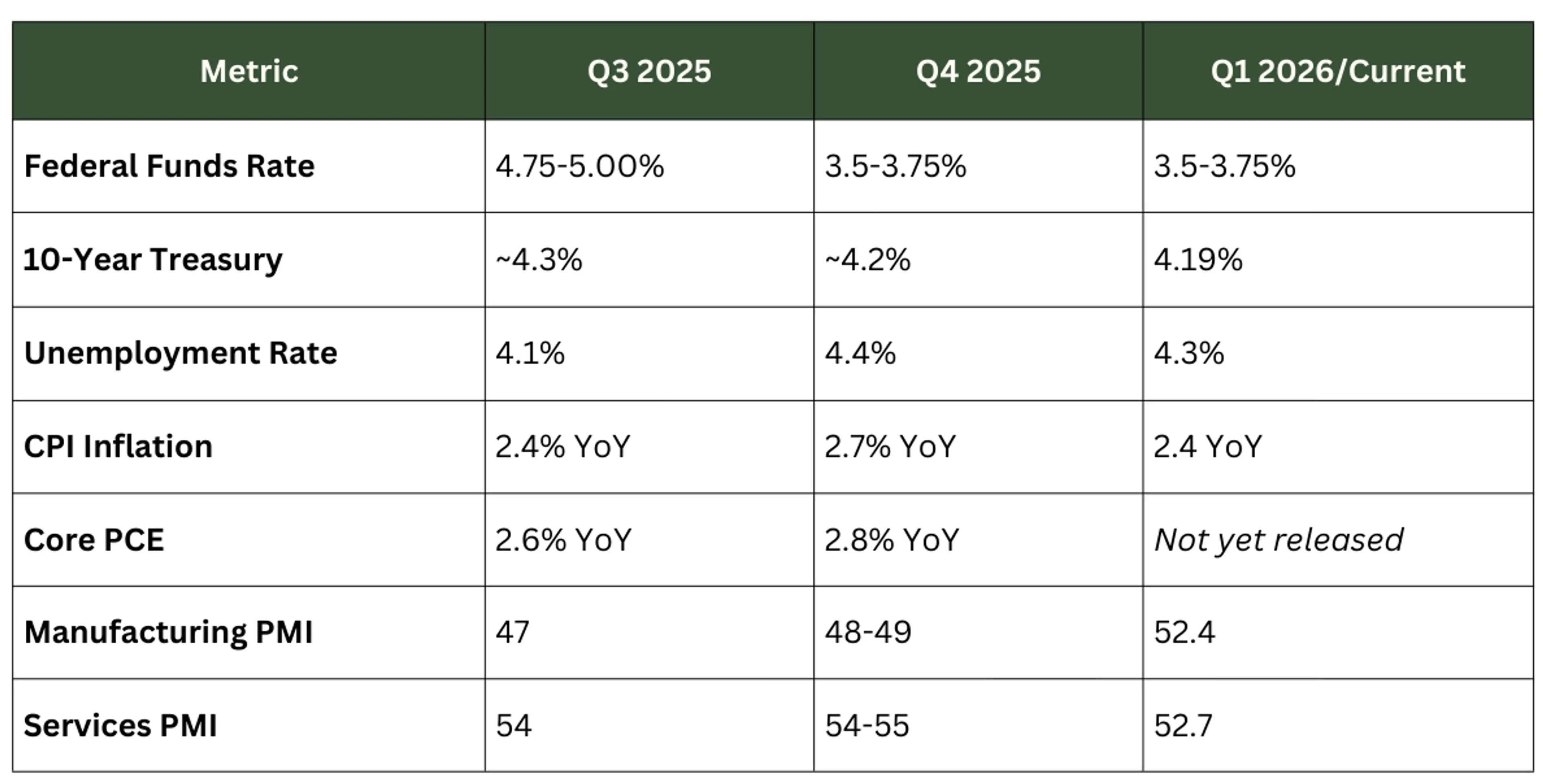
The Federal Reserve cut its benchmark rate by 25 basis points in each of September, November, and December 2025², bringing the federal funds rate to 3.50-3.75%³. However, the 10-year Treasury yield, which influences longer-term borrowing costs, remained elevated around 4.2%—higher than when the Fed began cutting⁴.
As of February 2026
"The market is pricing in expectations for stronger growth and persistent inflation," explains Jia-Mang Ten, Chief Investment Officer at Libertas Funding. "Even as the Fed cuts its policy rate, businesses are borrowing at rates that reflect market concerns about inflation sustainability. This creates a challenging but navigable environment for companies with solid fundamentals."
The divergence between Fed policy and market rates created an interesting dynamic: businesses anticipated relief from rate cuts but found financing costs stayed relatively stable. The fact that activity increased anyway speaks to the strength of underlying business confidence.
The Inflation Puzzle
Consumer price inflation ended 2025 at 2.7% year-over-year in December, well above the Federal Reserve's 2% target and showing little progress from mid-year levels. Core PCE inflation, the Fed's preferred measure, remained similarly elevated around 2.8%.
This stickiness in inflation explains why long-term rates haven't declined. The "last mile" of reducing inflation from roughly 3% to 2% is proving difficult. Services inflation, particularly in labor-intensive sectors, remains persistent despite cooling wage growth5.
"The Fed is in a wait-and-see mode," notes Ten. "They've delivered rate cuts but are now watching to see if inflation cooperates. If we see meaningful progress toward the 2% target in early 2026, additional cuts become more likely. But if inflation stays sticky, we could see a prolonged pause in rate reductions through much of the year."
Small Business Sentiment: The Real Story
The NFIB Small Business Optimism Index⁸ showed notable improvement through Q4 2025, with business owners citing stabilizing economic conditions and clearer visibility into 2026 as key factors in their improved outlook. This confidence translated quickly into action: capital expenditure plans that had been shelved earlier in 2025 came off the shelf, and businesses that had maintained operations conservatively began discussing expansion, hiring, and strategic investments.
"We saw a distinct change in conversations during Q4," notes John Paradisi, CEO of Libertas Funding. "Business owners who had been hesitant for months started making decisions. It wasn't that conditions became perfect—they didn't. But owners reached a point where sitting still felt riskier than moving forward, even with the current rate environment."
While the manufacturing sector was in contraction during Q4, January data showed a sharp reversal with PMI surging to 52.4⁷—the highest reading since February 2022. Services activity moderated slightly to 52.7⁷, still indicating expansion but down from Q4's elevated levels. This shift suggests a rebalancing across sectors as conditions evolve, with most SMBs operating in services sectors where conditions remained favorable⁷.
The Traditional Lender Dynamic
While business confidence improved, traditional bank lending standards remained cautious. Regional and community banks, still managing commercial real estate exposures, maintained conservative underwriting approaches even as the Fed cut rates. This created opportunity for specialized lenders who understand specific business models and industries.
"Traditional lenders remain cautious, and that's created opportunities for us," explains Paradisi. "We're seeing quality businesses that would have gotten bank financing a few years ago now coming to alternative lenders because banks are being selective. These aren't distressed situations—they're good companies that need partners who understand their specific circumstances."
With lower-cost bank debt less accessible, businesses increasingly valued expertise and flexibility over pure price.
What Early 2026 Signals Show
As of mid-February 2026, economic signals suggest Q4's optimism has carried into the new year with tangible momentum. The January unemployment rate held steady at 4.3%, representing a healthy labor market. Manufacturing PMI surged to 52.4⁷, marking a significant reversal from Q4's contraction⁷. Small business confidence remained above its 52-year average, though moderating slightly to 99.3⁸.
The Federal Reserve signaled it will move cautiously on further rate cuts, prioritizing inflation progress over providing additional stimulus. Markets expect at most two or three cuts in 2026, down from earlier expectations. Long-term rates have remained elevated around 4.2%, providing businesses with visibility for planning despite high levels.
The Sustainability Question
The central question for the remainder of 2026 is whether sentiment-driven momentum can sustain itself if rate relief doesn't materialize. Several factors will influence the answer:
If inflation moves convincingly toward the Fed's 2% target, rates could decline meaningfully. But if inflation remains sticky, borrowing costs will stay elevated and could begin to constrain activity. Corporate earnings through 2025 generally exceeded expectations, but high borrowing costs and wage pressures could begin squeezing margins. Consumer spending and business investment need to maintain their Q4 pace—any significant slowdown could create a feedback loop that undermines confidence.
"The biggest risk is that optimism runs ahead of fundamentals," cautions Ten. "If businesses invest aggressively expecting conditions to improve but rates stay high and inflation persists, we could see pullbacks later in 2026. The key is matching capital deployment to realistic expectations about the operating environment."
Early Q1 data validates Q4's optimism—businesses that acted decisively were reading economic momentum correctly. Manufacturing's return to expansion and stable employment support the case that confidence was grounded in fundamentals. The question now isn't whether that confidence was justified, but whether this momentum can sustain itself as the year progresses, particularly as services activity moderates and rate relief remains limited.
Positioning for Opportunity
The current environment rewards businesses that combine strategic clarity with operational flexibility. Companies that understand their strategic direction are moving forward despite imperfect economic conditions, recognizing that execution matters more than perfect timing. As capital prices converge and the era of cheap money ends, businesses prioritize partners who understand their business model over those simply offering the lowest rate. Successful companies build optionality into their capital structures, avoiding overleverage while maintaining the ability to act when opportunities emerge.
"Business leaders need to think beyond just the cost of capital," advises Paradisi. "In this environment, the right partner matters as much as the rate. The businesses succeeding right now are those that prioritize finding capital partners aligned with their strategic vision."
"We support businesses that turn market transitions into competitive advantages," notes Paradisi. "The best opportunities often emerge during uncertain periods. Companies with strong fundamentals and clear vision find that accessing the right capital—paired with partners who understand their business—enables them to capture market share while competitors remain cautious."
At Libertas, we facilitate capital access by understanding each business's unique positioning and competitive advantages, connecting companies with financing solutions that support their growth strategies. Having facilitated over $5 billion since 2016, we've supported businesses through multiple economic cycles, understanding that the best opportunities often emerge during periods of market transition.
Interested in discussing your business's growth financing needs? Connect with our team to learn how Libertas can support your strategic goals. https://libertasfunding.com/partner-with-us
References
¹Federal Reserve Bank of New York, Household Debt and Credit Report, Q4 2025 https://www.newyorkfed.org/microeconomics/hhdc
²Federal Reserve, Federal Open Market Committee Statements, September-December 2025 https://www.federalreserve.gov/monetarypolicy/fomccalendars.htm
³Federal Reserve, Selected Interest Rates (H.15) https://www.federalreserve.gov/releases/h15/
⁴U.S. Department of the Treasury, Daily Treasury Yield Curve Rates https://home.treasury.gov/resource-center/data-chart-center/interest-rates
⁵Bureau of Labor Statistics, Consumer Price Index Summary, December 2025 https://www.bls.gov/news.release/cpi.htm
⁶U.S. Census Bureau, Business Trends and Outlook Survey https://www.census.gov/data/experimental-data-products/btos.html
⁷S&P Global, U.S. Manufacturing PMI Report, January 2026 https://www.pmi.spglobal.com/Public/Home/PressRelease/cdb24b3e6f9c4b3584cfab900d2c80df
⁸National Federation of Independent Business, Small Business Economic Trends, January 2026 https://www.nfib.com/news/monthly_report/sbet/
This material is provided for informational purposes only and does not constitute financial advice or an offer to provide financing.
*Term Loans are issued by WebBank and serviced by Libertas pursuant to its partnership with the Bank.
About Libertas Funding: Founded in 2016 and headquartered in Greenwich, CT, Libertas Funding has facilitated over $5 billion in growth capital to small and medium-sized businesses. The company combines institutional-grade execution with personalized service. Learn more at libertasfunding.com.